|
 |
Margaret James Interview
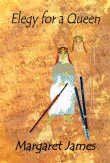
Elegy for a Queen
by Margaret James
|
Writewords talks to Margaret James, author of the newly published Elegy for a Queen, Solidus Books. For a full biography of her previous novels, visit www.jamesk.freeserve.co.uk
What’s your writing background?
I was a very imaginative child. I’m gregarious and sociable and always have been, but in addition to my real friends I had a lot of virtual friends, and spent much of my time in a world of my own (which I still do – it’s the best way to deal with the stress of modern living, believe me). I wrote hundreds of stories and poems – all now mercifully lost!
But doing a degree in English almost put me off writing for life. I ended up thinking that if I couldn’t write like Charles Dickens or E M Forster, what was the point? After I’d graduated I went into the Civil Service, got married, had some children, and read almost nothing while they were babies. I’m ashamed to admit I didn’t even belong to a library.
How, when and why did you first start writing?
Eventually I started reading again. I read all kinds of fiction, especially the sort of books I’d never read at university – thrillers, romances, family sagas, detective stories. Once I was reading again, it could only be a matter of time before I started to think, I could do that!
I started writing my first short story on the day my younger daughter started school. I also started the first draft of my first novel, and wrote that in about six weeks. After that, I was hooked and I’ve never looked back.
Who are your favourite writers/writing and why?
Jane Austen is my number one favourite because she is so clever, so witty, so intelligent and so brilliant at telling a really good story. She is the novelists’ novelist par excellence – we can all learn something from JA. I’m sure Nancy Mitford (another great favourite) couldn’t have written The Pursuit of Love if Jane Austen hadn’t shown her the way. I also love Dickens (especially Great Expectations, which is probably my favourite book of all time after Pride and Prejudice).
Among modern writers I enjoy the novels of Barbara Kingsolver and Bernard Cornwell, who both tell a jolly good story.
How did you feel when you first started sending your writing out into the world?
I wasn’t clued up enough to be apprehensive! In fact, I was so ignorant about the publishing industry that I sent my first attempt at a short story to Good Housekeeping magazine, then waited for the cheque to arrive – which of course it didn’t! But I did get a very kind, encouraging letter with my rejected story, so I kept going. I’ll always be grateful to that journalist at GH who bothered to be so kind to an unknown author.
What was your breakthrough moment ?
Selling an article about one of my children to Parents magazine.
How did you handle rejections?
If they’re just standard “no thank you” letters, I try to shrug them off and forget about them. But if they’re personal letters from editors, I try to learn from them. Some rejection letters are actually very helpful. Authors should try very hard not to take rejection personally – they should always remember that rejection letters apply to the piece of work in question, not to them as human beings.
What excites you about a piece of writing- what keeps you going, both as a writer and a reader?
... sign up to WriteWords to read more
|
Comments by other Members
| |
No comments at present.
To post comments you need to become a member. If you are already a member, please log in .
 
Comments:
This work can only be commented on by group members.
|
|
|
|


 Comments by other Members
